
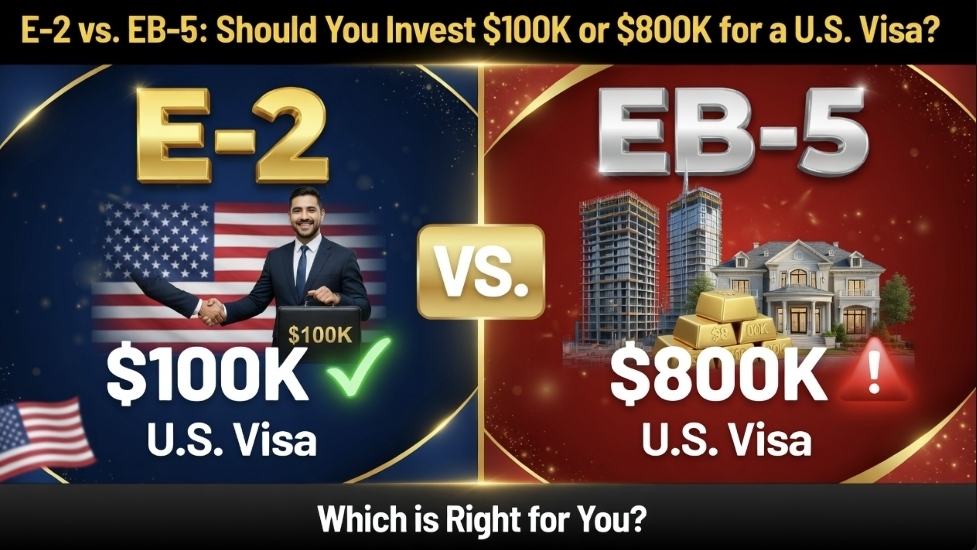
Securing a legal pathway to live and do business in the United States is a primary goal for many global investors. However, the financial entry points vary drastically. The choice frequently boils down to a critical question: Should you deploy around $100,000 for an E-2 Treaty Investor Visa, or commit at least $800,000 for an EB-5 Immigrant Visa?
Both options unlock the doors to the American economy, but they demand entirely different capital structures, risk tolerances, and long-term residency goals. Allocating your net worth incorrectly can tie up your liquidity for years or result in avoidable immigration delays. Let’s compare the financial and legal realities of both pathways.
E-2 vs. EB-5: Core Operational Differences
Your broader wealth strategy dictates which visa type fits your portfolio. The two programs stack up differently across the key operational metrics that matter to your capital:
| Key Metrics | E-2 Treaty Investor Visa | EB-5 Immigrant Visa |
|---|---|---|
| Minimum Capital Requirement | No official minimum (Typically $100K – $150K+) | $800,000 (Targeted Employment Area) |
| Immigration Status | Non-Immigrant (Renewable indefinitely) | Immigrant (Permanent U.S. Green Card) |
| Processing Timelines | Fast: 2 to 4 months (Premium available) | Moderate to Slow: 1 to 3+ years |
| Investor’s Daily Role | Active: Must direct and manage the business | Passive: Handled by a Regional Center project |
| Source of Funds Scrutiny | Standard asset verification | Extremely strict, multi-layered forensic audit |
The $100K Strategy: E-2 Visa for High Capital Liquidity
The E-2 visa serves as a highly agile tool for active entrepreneurs. Because immigration law only requires a “substantial” investment relative to the business type, starting or buying a franchise for roughly $100,000 to $150,000 is completely viable. This route keeps your initial capital outlay low and preserves your liquidity.
💡 Strategic Benefits of the E-2 Option:
It operates as a rapid-response mechanism. You can move your family to the United States in just a few months. While it does not automatically yield a permanent Green Card, the visa can be renewed indefinitely as long as the small business remains operational, profitable, and contributes to the local economy. It grants immediate access to U.S. education for your children and a flexible open work permit for your spouse.
The $800K Strategy: EB-5 Visa for Permanent Green Cards
If you view immigration strictly through the lens of asset allocation and want a clear, hands-off exit strategy, the EB-5 visa is the gold standard. The baseline capital requirement starts at $800,000 for Targeted Employment Areas (TEAs), but this large allocation buys an invaluable asset: unconditional permanent residency for your family.
By investing in a certified EB-5 Regional Center project, you step away from daily management, hiring logistics, and operational liabilities. Professional developers manage the business to fulfill the USCIS requirement of creating 10 full-time U.S. jobs. Once approved, you are free to live, work, or retire anywhere in the United States without being tied to a specific business entity.
The Verdict: Aligning the Visa with Your Capital Portfolio
Choosing between $100,000 and $800,000 isn’t just about how much liquid cash is available; it is about how much time and active management you want to invest.
Select the EB-5 Visa if: Your primary objective is a direct, permanent pathway to U.S. citizenship, you prefer an entirely passive investment structure, and you possess a perfectly traceable source of funds to pass a deep forensic audit.
Many high-net-worth families implement a hybrid **”Bridge Strategy”**. They enter the United States rapidly via a low-cost E-2 franchise to establish residency immediately, then file for an EB-5 adjustment of status later once their larger, long-term asset portfolios are fully liquidated. Coordinating your immigration timeline with your personal wealth protection goals is the ultimate framework for long-term success.