
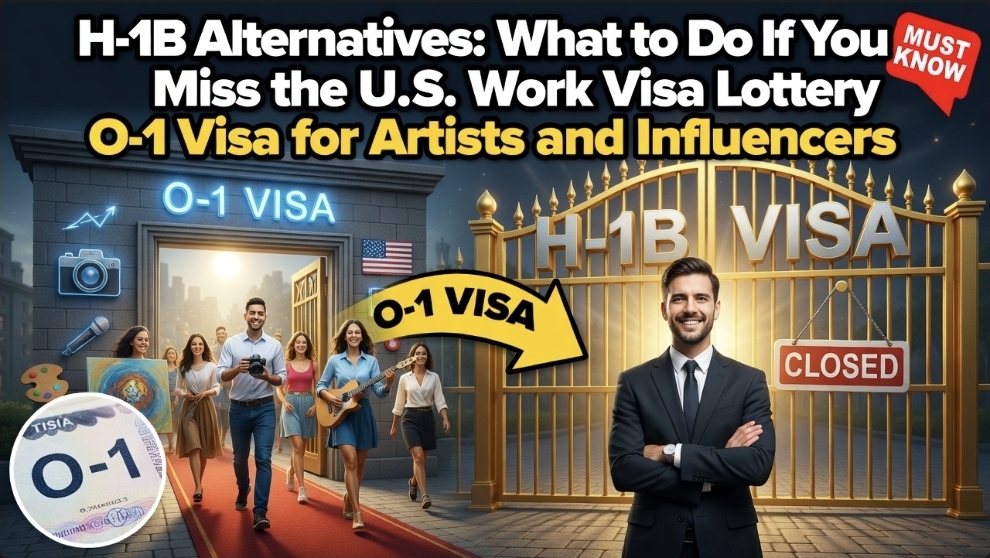
Missing out on the H-1B visa lottery can feel like a devastating roadblock for professionals aspiring to build their careers in the United States. With annual caps capped at 85,000 and hundreds of thousands of applicants vying for a spot each year, the lottery system relies heavily on pure luck rather than individual merit or professional talent. For creative minds, digital content creators, and social media influencers, however, this setback does not mean the end of the American dream.
There is a powerful, highly flexible, and merit-based alternative that many overlooked: the O-1B Visa for Individuals with Extraordinary Ability in the Arts. Unlike the H-1B, the O-1 visa does not cap its applicant pool, does not require a rigid university degree, and rewards you directly for your actual industry impact and creative achievements. In this comprehensive guide, we will break down everything you need to know about transitioning your immigration strategy from the H-1B lottery to the O-1B visa pathway.
1. Understanding the O-1B Visa: The Lottery-Free Alternative
The O-1 visa category is specifically reserved for individuals who have risen to the very top of their field. It is split into two subcategories: O-1A (for science, education, business, and athletics) and O-1B (for the arts, motion pictures, and television industries). For designers, fine artists, musicians, and modern digital influencers, the O-1B visa is the designated target.
To understand why the O-1B is often superior to the H-1B for creative professionals, let us compare their core structural differences:
- No Annual Cap or Lottery: The biggest frustration with the H-1B is the random selection process. The O-1B visa completely eliminates this. There is no lottery. If you meet the criteria and submit a strong petition, you can be approved at any time of the year.
- No Strict Degree Requirement: The H-1B is a “specialty occupation” visa, meaning you must hold at least a bachelor’s degree directly related to your job title. The O-1B focuses entirely on your portfolio, track record, and industry recognition. An outstanding self-taught artist with zero degrees can qualify over a university graduate with no portfolio.
- Indefinite Extensions: While the H-1B has a hard limit of six years (unless a green card process is underway), the O-1 visa is granted for up to three years initially and can be extended indefinitely in one-year increments as long as you continue your creative work in the United States.
2. The Evolution of the “Artist” Status: Enter the Digital Influencer
Historically, the O-1B visa was associated exclusively with traditional fine artists, classical musicians, Broadway actors, and Hollywood directors. However, the United States Citizenship and Immigration Services (USCIS) has evolved significantly to match the modern digital economy.
Today, the legal definition of “the arts” under U.S. immigration regulations includes any creative field or endeavor. This broad interpretation has opened the doors for a massive wave of new-media professionals, including:
- Digital Content Creators: Full-time YouTubers, TikTok content creators, podcasters, and stream personalities.
- Social Media Influencers: Individuals in fashion, beauty, travel, fitness, or tech who command large, highly engaged digital audiences.
- Creative Tech Professionals: UI/UX designers, game developers, VFX artists, and 3D animators.
- Commercial Artists: Graphic designers, fashion stylists, creative directors, commercial photographers, and brand consultants.
If your career relies on creating unique content, building a personal brand, or shaping visual culture, USCIS legally recognizes your profession as an eligible art form.
3. Deep Dive: The Legal Criteria for O-1B Success
To win an O-1B visa approval, you must prove that you have achieved “distinction” in your field. Legally, this means you are a prominent, leading, or well-known figure in the arts. You can satisfy this by showing you have won a major international award (like an Emmy, Grammy, or Academy Award), OR by providing documentation that satisfies at least three (3) of the following six criteria:
Criterion 1: Lead or Starring Role in Distinguished Productions
You must demonstrate that you have performed, or will perform, a critical or starring role in events, productions, or organizations that have a distinguished reputation. For traditional artists, this means being the lead designer for a major brand or the main performer at a famous festival. For influencers, this can be proven by showing you were the primary face of a major global marketing campaign or a headline creator for a massive digital event.
Criterion 2: National or International Media Recognition
Your work and achievements must be featured in major published materials, trade journals, or mainstream media outlets. Local blogs or self-published articles do not carry weight. You need features in reputable magazines, national newspapers, or highly authoritative industry websites. For example, being interviewed by Forbes, featured in Vogue, or profiled by TechCrunch serves as excellent evidence.
Criterion 3: Critical Role for Distinguished Organizations
This requires proof that you have served in a critical or essential capacity for organizations and establishments that have a great reputation. If you were a key creative asset for a highly respected marketing agency, or if you signed an exclusive deal with a top-tier Multi-Channel Network (MCN), you can meet this requirement through detailed letters of support from executives within those organizations.
Criterion 4: Major Commercial or Critically Acclaimed Successes
You must show a record of major commercial or critically acclaimed successes. This is where data becomes your best friend. For traditional media, this includes box office receipts, album sales, or gallery sellouts. For digital influencers, you can present analytics showing millions of video views, exceptionally high audience engagement rates, trending hashtags, or record-breaking traffic driven to an e-commerce partner.
Criterion 5: Significant Recognition from Industry Experts
You must submit testimonials and recommendation letters from recognized experts in your field. These letters cannot be generic testimonials from casual colleagues. They must be detailed, authoritative narratives written by industry leaders who explain your unique talents, describe your major contributions to the market, and state clearly why you are considered an extraordinary asset to the industry.
Criterion 6: High Salary or Substantial Remuneration
You must command a high salary or other substantial remuneration for your services compared to others in your field. In the influencer and creator world, this is demonstrated through high-paying brand sponsorship contracts, substantial platform monetization payouts, or lucrative affiliate revenue streams that sit significantly above the median income for standard media workers.
4. Actionable Strategy: How to Build Your O-1B Case as an Influencer
If you are planning to transition from an H-1B mentality to an O-1B strategy, you must change how you catalog your daily career. You are no longer just an employee working for a corporate entity; you are a brand and a distinct public asset. Use the following step-by-step strategy to construct an unassailable visa petition:
- Audit and Clean Your Analytics: Download comprehensive, verifiable data reports from YouTube, Instagram, TikTok, or your web hosting platforms. Focus heavily on Engagement Rates (likes, comments, shares, saves) rather than just raw follower numbers. USCIS looks for genuine, active influence, not bought or passive audiences.
- Aggressively Pursue Public Relations (PR): Do not wait for journalists to find you. Actively pitch your unique stories, innovative campaigns, or creative business strategies to industry publications. Getting a few high-quality, dedicated feature articles written about your creative journey can instantly satisfy the media recognition requirement.
- Secure an Authorized U.S. Agent or Sponsor: Because many artists and influencers work freelance or take on multiple projects, an O-1B visa is frequently filed through a “U.S. Agent” rather than a single traditional employer. This agent can represent you as a manager, allowing you to sign contracts with multiple brands and clients across America under an overarching itinerary of work.
- Standardize Your Contracts: Ensure all brand deals, agency representation contracts, and sponsorship agreements are clearly written out on formal letterheads, detailing exact payment structures, campaign timelines, and your specific creative responsibilities.